
 News & Info
 Videos
 Access
 Contact

 Instagram

 View on Twitter

Access
Headquarters
(Koganei, Tokyo)
Kashima Space
Technology Center
(Kashima, Ibaraki)
CubeSOTA mission
:Miniaturized Lasercom Terminal in Low Earth Orbit
 HOME
>
Research Projects
>
CubeSOTA mission:Miniaturized Lasercom Terminal in Low Earth Orbit
HOME
>
Research Projects
>
CubeSOTA mission:Miniaturized Lasercom Terminal in Low Earth Orbit
CubeSOTA mission
The CubeSOTA (CubeSat Small Optical Transponder) mission will use a 6U CubeSat (30 × 20 × 10 cm) to validate a miniaturized free-space laser communication terminal in space. This will be the first in-orbit validation of the terminals developed by NICT in recent years. Following the successful SOTA (Small Optical TrAnsponder) mission a decade ago, the CubeSOTA mission aims to demonstrate bidirectional optical links in low Earth orbit (LEO) at data rates of up to 10 Gbit/s using a variety of innovative lasercom technologies. It is scheduled to be launched in fiscal year 2026 on a SpaceX Falcon 9 rocket.
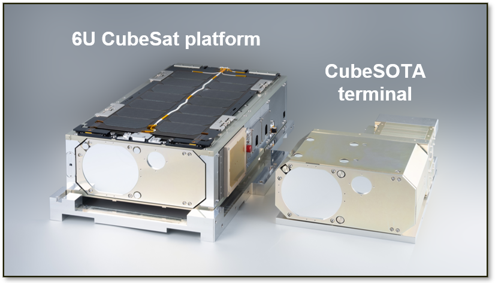 Research overview: Developing Technologies to Establish High-Speed Satellite Communications
Mission Objectives:
The mission focuses on two main communication scenarios:
- LEO-to-Ground: Establishing 10 Gbit/s lasercom links with Optical Ground Stations (OGS) in Japan and overseas.
- LEO-to-HAPS: Demonstrating lasercom links with a High-Altitude Platform Station (HAPS) in the stratosphere (~20 km).
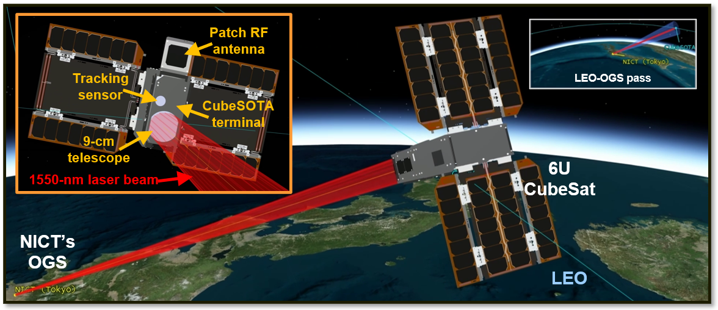 Research overview: Developing Technologies to Establish High-Speed Satellite Communications
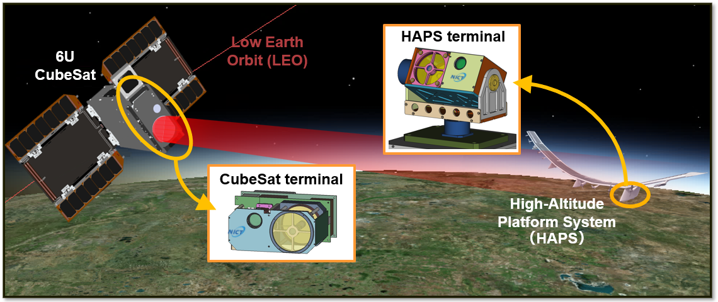 Research overview: Developing Technologies to Establish High-Speed Satellite Communications
Technical specifications:
The CubeSOTA lasercom payload occupies ~3U of volume and has a total mass of ~4 kg. Its key technical components include:
- Gimbal-Less Coarse Tracking: Coarse tracking is handled directly by the satellite bus attitude determination and control system (ADCS) in a closed loop with a 3-cm-aperture coarse tracking sensor.
- 9-cm Cassegrain Telescope: Enables a narrow beam divergence of ~20 µrad FWHM, the narrowest ever transmitted from a CubeSat lasercom terminal, and maximizes the collection of uplink light.
- Beam Divergence Control (BDC): this system can control beam divergence to facilitate initial link acquisition and adapt to distance and pointing requirements.
- High-Power Vacuum MEMS Mirrors: Two tip-tilt MEMS mirrors for fine pointing and point-ahead angle correction customized to steer a high-power small optical beam in a vacuum while preserving wavefront quality.
- Integrated EDFA Module: A 2-in-1 miniaturized optical amplifier unit housing a 2-W high-power amplifier (HPA) for the transmitter and a low-noise preamplifier (LNA) for the receiver.
- 10G Modem: Integrates FEC, interleaving, 1 TB of internal memory for store-and-forward operation, a real-time loopback mode, and a variable data-rate function (1 to 10 Gbit/s).
- Full-Duplex: Capability to transmit and receive at 10 Gbit/s, aiming to demonstrate, for the first time, a LEO lasercom uplink based on SMF coupling + optical amplification.

Publications
- Alberto Carrasco-Casado, Koichi Shiratama, Dimitar Kolev, Hiroyuki Tsuji, Amane Miura, Morio Toyoshima, "Overview of the CubeSOTA mission: A miniaturized lasercom terminal onboard a 6U CubeSat," 2025 IEEE International Conference on Space Optical Systems and Applications (ICSOS) (2026)
- Alberto Carrasco-Casado, Koichi Shiratama, Dimitar Kolev, Hiroyuki Tsuji, Morio Toyoshima, "Development and environmental validation of a compact EDFA with integrated LNA+HPA for satellite optical communications," Frontiers in Physics, Volume 13 (2025)
- Alberto Carrasco-Casado, Koichi Shiratama, Dimitar Kolev, Fumie Ono, Hiroyuki Tsuji, Morio Toyoshima, "Miniaturized Multi-Platform Free-Space Laser-Communication Terminals for Beyond-5G Networks and Space Applications," MDPI Photonics, Volume 11, Issue 6 (2024)
- Alberto Carrasco-Casado, Koichi Shiratama, Dimitar Kolev, Phuc V. Trinh, Femi Ishola, Tetsuharu Fuse and Morio Toyoshima, "Development of a miniaturized CubeSat’s 2-W EDFA for 2 space laser communications," MDPI Electronics, Volume 11, Issue 15 (2022)
- Alberto Carrasco-Casado, Koichi Shiratama, Phuc V. Trinh, Dimitar Kolev, Femi Ishola, Tetsuharu Fuse, Hiroyuki Tsuji and Morio Toyoshima, "NICT's versatile miniaturized lasercom terminals for moving platforms," 2022 IEEE International Conference on Space Optical Systems and Applications (ICSOS) Pages 213-217 (2022)
- Alberto Carrasco-Casado, Koichi Shiratama, Phuc V. Trinh, Dimitar Kolev, Yasushi Munemasa, Tetsuharu Fuse, Hiroyuki Tsuji and Morio Toyoshima, "Development of a miniaturized laser-communication terminal for small satellites," Acta Astronautica, Volume 197, Pages 1-5 (2022)
- Alberto Carrasco-Casado, Koichi Shiratama, Dimitar Kolev, Phuc V. Trinh, Tetsuharu Fuse, Hiroyuki Tsuji, Shingo Fuse, Koji Kawaguchi, Yusuke Hashimoto, Masamitsu Hyodo, Takashi Sakamoto, Terufusa Kunisada and Morio Toyoshima, "Prototype Development and Validation of a Beam-Divergence Control System for Free-Space Laser Communications," Frontiers in Physics, Volume 10 (2022)
- Alberto Carrasco-Casado, "Free-space Laser Communications for Small Moving Platforms,” M4I.1. San Diego, California, United States: Optical Fiber Communication Conference (2022) (invited paper)
- Alberto Carrasco-Casado, “Development of a miniaturized laser-communication terminal for small satellites,” International Astronautical Congress (IAC) (2021)
- Alberto Carrasco-Casado, “Ultra-fast laser communications will open a new world of possibilities for CubeSats,” NICT News (2021)
- Alberto Carrasco-Casado, “High-speed communications with CubeSats,” Nikkan Kogyo Shimbun (2020)
- Alberto Carrasco-Casado, Phong Xuan Do, Dimitar Kolev, Takayuki Hosonuma, Koichi Shiratama, Hiroo Kunimori, Phuc V. Trinh, Yuma Abe, Shinichi Nakasuka and Morio Toyoshima, "Intersatellite-Link Demonstration Mission between CubeSOTA (LEO CubeSat) and ETS9-HICALI (GEO Satellite)," 2019 IEEE International Conference on Space Optical Systems and Applications (ICSOS) Pages 1-5 (2019)
- Alberto Carrasco-Casado, Abhijit Biswas, Renny Fields, Brian Grefenstette, Fiona Harrison, Suzana Sburlan and Morio Toyoshima, "Optical communication on CubeSats — Enabling the next era in space science," 2017 IEEE International Conference on Space Optical Systems and Applications (ICSOS) Pages 46-52 (2017)
Members

Support us

Collaborate with us

Use this technology
CONTACT
If you have any questions for the Space Communication Systems Lab., please contact us by using our inquiry form.

 Twitter
 Instagram
Copyright © 2019 Wireless Networks Research Center. All Rights Reserved.