
 News & Info
 Videos
 Access
 Contact

 Instagram

 View on Twitter

Access
Headquarters
(Koganei, Tokyo)
Kashima Space
Technology Center
(Kashima, Ibaraki)
Optical Communications
:Free-Space Optical Communications
 HOME
>
Research Projects
>
Optical Communications:Free-Space Optical Communications
HOME
>
Research Projects
>
Optical Communications:Free-Space Optical Communications
Optical Communications:Free-Space Optical Communications
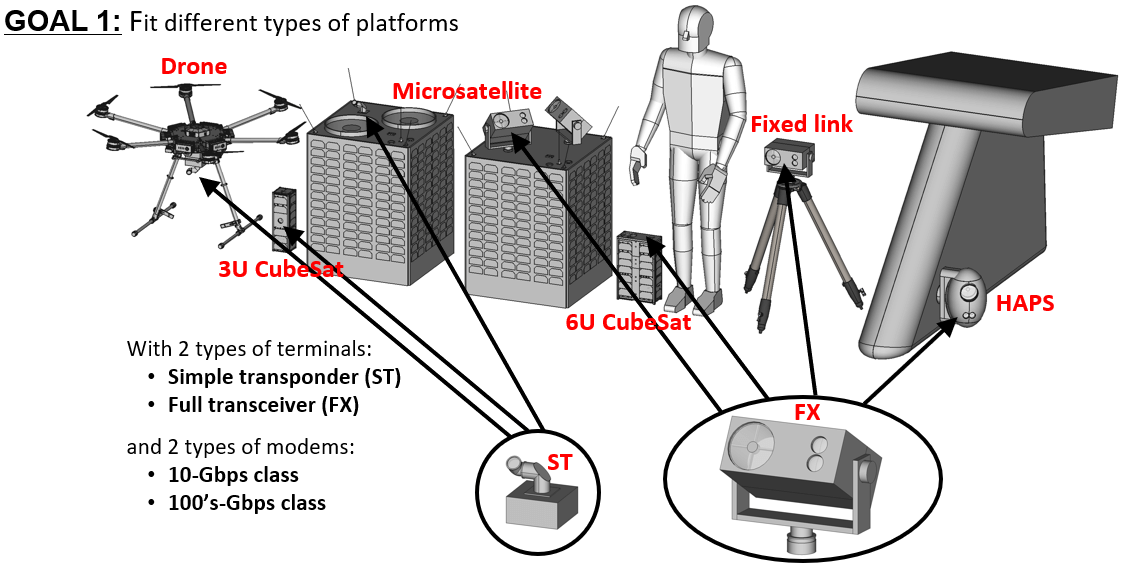
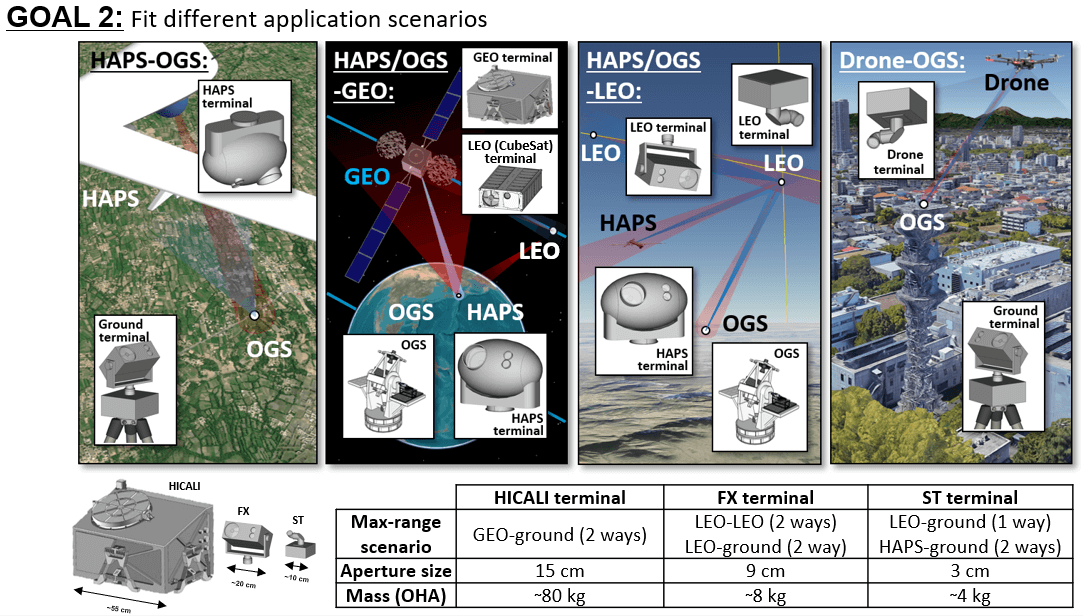
At the Space Communication Systems Laboratory, we conduct research and development of optical communication systems that take into account:
- Installation on a wide variety of platforms, ranging from small drones to large satellites
- Application to diverse optical communication scenarios, from fixed ground links to mobile platforms
- Communications under various conditions and distances, from short-range links to long-distance links extending into space
In order to achieve optimal solutions while accommodating these diverse requirements, NICT is organizing and defining the functions that optical communication terminals should possess. Based on this approach, we are currently conducting research on two types of terminals.
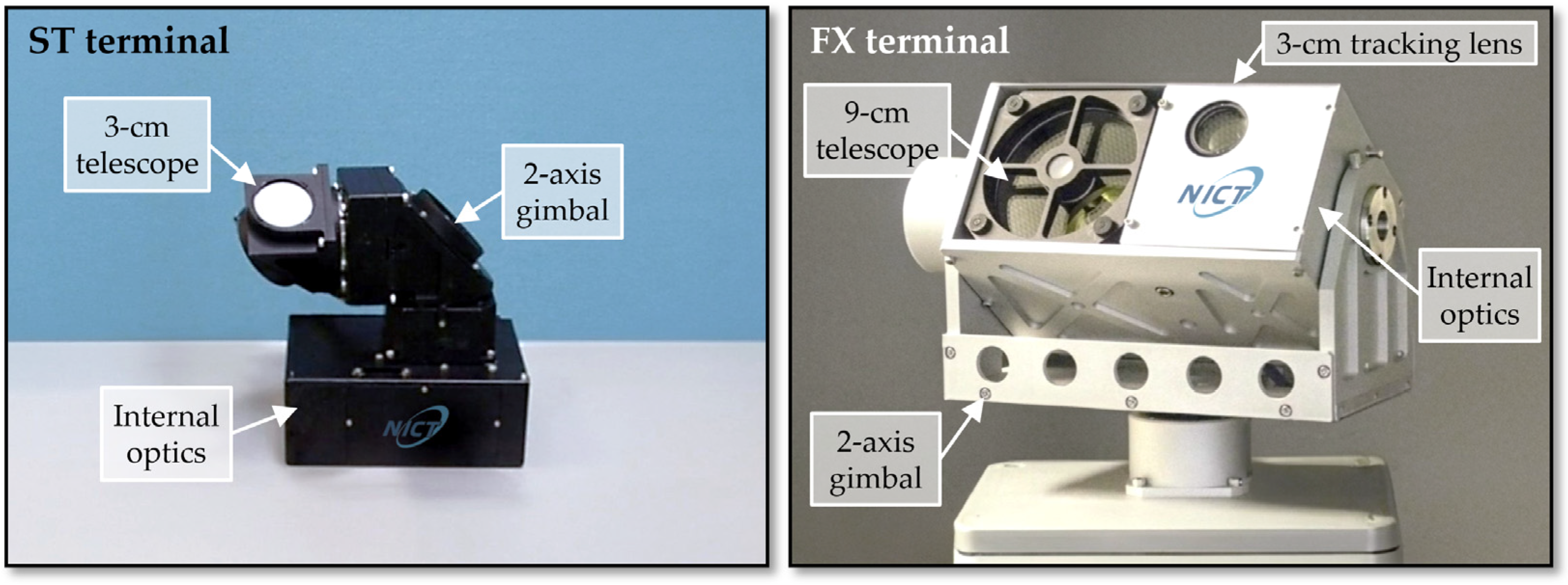
These two types of optical communication terminals are referred to as the Full Transceiver (FX) and the Simple Transponder (ST).
- Full Transceiver (FX): A terminal equipped with the necessary functions for high-speed, long-distance, and bidirectional links
- Simple Transponder (ST): A terminal in which some functions of the FX are reduced or constrained in terms of size, mass, and power consumption
In addition, the transmission rates of the optical modulators/demodulators for these terminals are assumed as follows:
- Variable transmission rates ranging from 0.6 to 10 Gbps to adapt to diverse channel characteristics
- Realization of ultra-high-speed, large-capacity optical communications at hundreds of Gbps to several Tbps by utilizing multiple optical signals with different wavelengths
Through these research efforts, we aim to realize an advanced information and communications network that seamlessly connects the ground and space.
These terminals have been validated through several field trials, including a 2024 demonstration using the 10 Gbps modem with the two terminals separated by 7.4 km in daylight and under strong atmospheric turbulence. More recently, in 2025, the same test was repeated with the 2 Tbps prototype modem, achieving the first-ever Tbps-class link using compact lasercom terminals suitable for deployment on moving platforms such as HAPS and satellites.
 Research overview: Developing Technologies to Establish High-Speed Satellite Communications
 Research overview: Developing Technologies to Establish High-Speed Satellite Communications
 Research overview: Developing Technologies to Establish High-Speed Satellite Communications

Publications
- Alberto Carrasco-Casado, Koichi Shiratama, Dimitar Kolev, Fumie Ono, Hiroyuki Tsuji, Morio Toyoshima, "Miniaturized Multi-Platform Free-Space Laser-Communication Terminals for Beyond-5G Networks and Space Applications," MDPI Photonics, Volume 11, Issue 6 (2024)
- Alberto Carrasco-Casado, Koichi Shiratama, Dimitar Kolev, Phuc V. Trinh, Femi Ishola, Tetsuharu Fuse and Morio Toyoshima, "Development of a miniaturized CubeSat’s 2-W EDFA for 2 space laser communications," MDPI Electronics, Volume 11, Issue 15 (2022)
- Alberto Carrasco-Casado, Koichi Shiratama, Phuc V. Trinh, Dimitar Kolev, Femi Ishola, Tetsuharu Fuse, Hiroyuki Tsuji and Morio Toyoshima, "NICT's versatile miniaturized lasercom terminals for moving platforms," 2022 IEEE International Conference on Space Optical Systems and Applications (ICSOS) Pages 213-217 (2022)
- Alberto Carrasco-Casado, Koichi Shiratama, Phuc V. Trinh, Dimitar Kolev, Yasushi Munemasa, Tetsuharu Fuse, Hiroyuki Tsuji and Morio Toyoshima, "Development of a miniaturized laser-communication terminal for small satellites," Acta Astronautica, Volume 197, Pages 1-5 (2022)
- Alberto Carrasco-Casado, Koichi Shiratama, Dimitar Kolev, Phuc V. Trinh, Tetsuharu Fuse, Hiroyuki Tsuji, Shingo Fuse, Koji Kawaguchi, Yusuke Hashimoto, Masamitsu Hyodo, Takashi Sakamoto, Terufusa Kunisada and Morio Toyoshima, "Prototype Development and Validation of a Beam-Divergence Control System for Free-Space Laser Communications," Frontiers in Physics, Volume 10 (2022)
- Alberto Carrasco-Casado, "Free-space Laser Communications for Small Moving Platforms,” M4I.1. San Diego, California, United States: Optical Fiber Communication Conference (2022) (invited paper)
- Alberto Carrasco-Casado, “Development of a miniaturized laser-communication terminal for small satellites,” International Astronautical Congress (IAC) (2021)
- Alberto Carrasco-Casado, “Ultra-fast laser communications will open a new world of possibilities for CubeSats,” NICT News (2021)
- Alberto Carrasco-Casado, “High-speed communications with CubeSats,” Nikkan Kogyo Shimbun (2020)
- Alberto Carrasco-Casado, Phong Xuan Do, Dimitar Kolev, Takayuki Hosonuma, Koichi Shiratama, Hiroo Kunimori, Phuc V. Trinh, Yuma Abe, Shinichi Nakasuka and Morio Toyoshima, "Intersatellite-Link Demonstration Mission between CubeSOTA (LEO CubeSat) and ETS9-HICALI (GEO Satellite)," 2019 IEEE International Conference on Space Optical Systems and Applications (ICSOS) Pages 1-5 (2019)
- Alberto Carrasco-Casado, Abhijit Biswas, Renny Fields, Brian Grefenstette, Fiona Harrison, Suzana Sburlan and Morio Toyoshima, "Optical communication on CubeSats — Enabling the next era in space science," 2017 IEEE International Conference on Space Optical Systems and Applications (ICSOS) Pages 46-52 (2017)
Members

Support us

Collaborate with us

Use this technology
CONTACT
If you have any questions for the Space Communication Systems Lab., please contact us by using our inquiry form.

 Twitter
 Instagram
Copyright © 2019 Wireless Networks Research Center. All Rights Reserved.